Detailed Information on Construction Flyer
- TOP
- Language
- Kobe City Waterworks Bureau
- Detailed Information on Construction Flyer
- ●Kobe City conducts water pipe maintenance or cleaning work that may cause rusty (reddish) water, temporary water outages (interruptions to water supply), or a need for water conservation measures. When the city conducts these operations, the Waterworks Bureau distributes notices to residents in the affected areas in advance (except during emergencies).
- ●During the scheduled maintenance or cleaning period, the Waterworks Bureau will discharge cloudy and discolored water from nearby fire hydrants. This process and the use of equipment may cause noise, but we will try to minimize disturbances as much as possible. We appreciate your understanding and cooperation.
Rusty (Reddish) Water
- ●Please refrain from turning on your faucets and using water during scheduled maintenance hours. If you need to use the toilet, please prepare water in advance by filling up your bathtub or a bucket beforehand, and use that water to pour into the toilet bowl to flush. (Do not use bidet functions.)
- ●After the maintenance/cleaning work has been completed, you may resume using water as usual. (Please note that no notice will be given to announce the end of the work.)
- ●When first turning on the water supply after maintenance has finished, white water (cloudy water caused by air bubbles) or rusty water (murky reddish water) may come out. In such cases, please run water from a faucet OTHER than those connected to toilets, water heaters, or water filters for a period of time, then check again for any abnormalities before using the water.
Frequently Asked Questions:
Q1: Does rusty water negatively impact my health?
A1: Rusty water is caused by iron rust and other substances. While it does not pose any health risks, it may affect
the appearance and taste of the water. As such, we ask that you refrain from using tap water during the
maintenance/cleaning period.
Q2: What sort of problems may occur if rusty water enters the water supply pipes?
A2: If water is used during the maintenance/cleaning period, rusty water may enter the supply pipes, and particles
from rust and other sediments could clog filters in household appliances. Specifically, the following issues may
occur, so please refrain from using water during maintenance:
※ Water may not come out due to rust particles clogging the pipes, leading to malfunctions in water supply
equipment
※ Rusty water may affect all units of an apartment building
※ In the event rust particles clog the pipes and stops water flow, the Waterworks Bureau may be unable to provide
support
Q3: Can I use the toilet during the maintenance/cleaning period?
A3: Yes, you may use the toilet, however do NOT use the bidet or flush functions. To flush your toilet, please
ensure that you prepare stored water in advance by filling up a bathtub or bucket beforehand, and use that water
to pour directly into the toilet bowl to flush. Please be advised that using bidet functions such as washlets
can cause rust particles to clog the nozzles, and lead to malfunctions.
Q4: I use an electric water heater (such as EcoCute). Should I turn off the water supply valve?
A4: Please avoid supplying water to electric water heaters, and first and foremost, refrain from using hot water
during the maintenance/cleaning period.
To shut off the water supply valve, please refer to the instruction manual for your specific water supply equipment,
or contact the manufacturer for guidance, as the procedure to shut off the water supply varies by manufacturer.
Furthermore, please note that electric water heaters such as EcoCute store water in an internal tank and heat it
using off-peak electricity. Using hot water during the work period may cause the water heater to automatically draw
in rusty water into its internal tank, leading to water quality issues and malfunction.
Q5: The notice says in cases where white water or rusty water is coming out of the faucet, “please run water from
a faucet OTHER than those connected to toilets, water heaters, or water filters for a period of time, then check
again for any abnormalities before using the water.” Which faucet specifically should I use, and how long
specifically should I run the water?
A5: Please use the faucets in your bathroom sink or kitchen sink, and run COLD water until it turns clear. The time
you will need to keep your faucet running may vary—in some cases, the water may clear up in 1-2 minutes, while in
other cases it may take more than 30 minutes.
Q6: What is water pipe maintenance and cleaning work? Is it really necessary?
A6: In order to efficiently supply water to residents, maintenance work such as controlling water flow inside the
pipes, replacing old pipes, and repairing leaks is necessary. These types of procedures require valve operations,
which may cause changes in water flow or temporary water outages. As a result, rust and other particles on the inner
walls of the pipes may come loose, leading to the appearance of reddish, rusty water. Cleaning work is also
necessary in order to minimize the impact of such discolorations by discharging the rusty water from fire hydrants,
etc, which ensures that all residents have a safe and reliable supply of clean tap water.
Q7: Can you do the cleaning work during the daytime instead of at night?
A7: Waterworks and pipe cleaning operations often require partial road occupation. Depending on road conditions, it
is necessary to carry out the work during hours with less traffic. Additionally, operations are conducted during
nighttime hours in consideration of its content and impact; water usage is typically lower during nighttime, and
thus minimizes inconvenience to residents.
Water Outage (Temporary Suspension of Water Supply)
- ●During a temporary water outage, please do not open any faucets to check if water supply has been suspended, and ensure that all faucets are closed.
- ●If you need to use the toilet during the water outage, please ensure that you prepare stored water in advance by filling up a bathtub or bucket beforehand, and use that water to pour directly into the toilet bowl to flush. Please be advised that using bidet functions such as washlets can cause rust particles to clog the nozzles and lead to malfunctions.
- ●Once the scheduled work period has ended, you may resume using faucets and tap water as usual. (Please note that there will be no notices to announce the end of the work)
- ●When first turning on the water supply after maintenance/cleaning has finished, white water (cloudy water caused by air bubbles) or rusty water (murky reddish water) may come out. In such cases, please run water from a faucet OTHER than those connected to toilets, water heaters, or water filters for a period of time, then check again for any abnormalities before using the water.
Frequently Asked Questions:
Q8: What does “ensure that all faucets are closed” mean? Does it mean that water might still come out even during
the water outage?
A8: Yes, even during a scheduled water outage, a small amount of water remaining in the pipes may still come out if
a faucet is opened.
This notice acts as a precaution, as people may try to check if the water supply has actually been suspended by
turning their faucet on during a temporary outage, and then forget to shut off their faucet afterwards. This is
dangerous, as water could overflow from the open faucet once the water supply is restarted, causing flooding in the
bathroom and water damage to the surrounding units as well.

Conserving Water
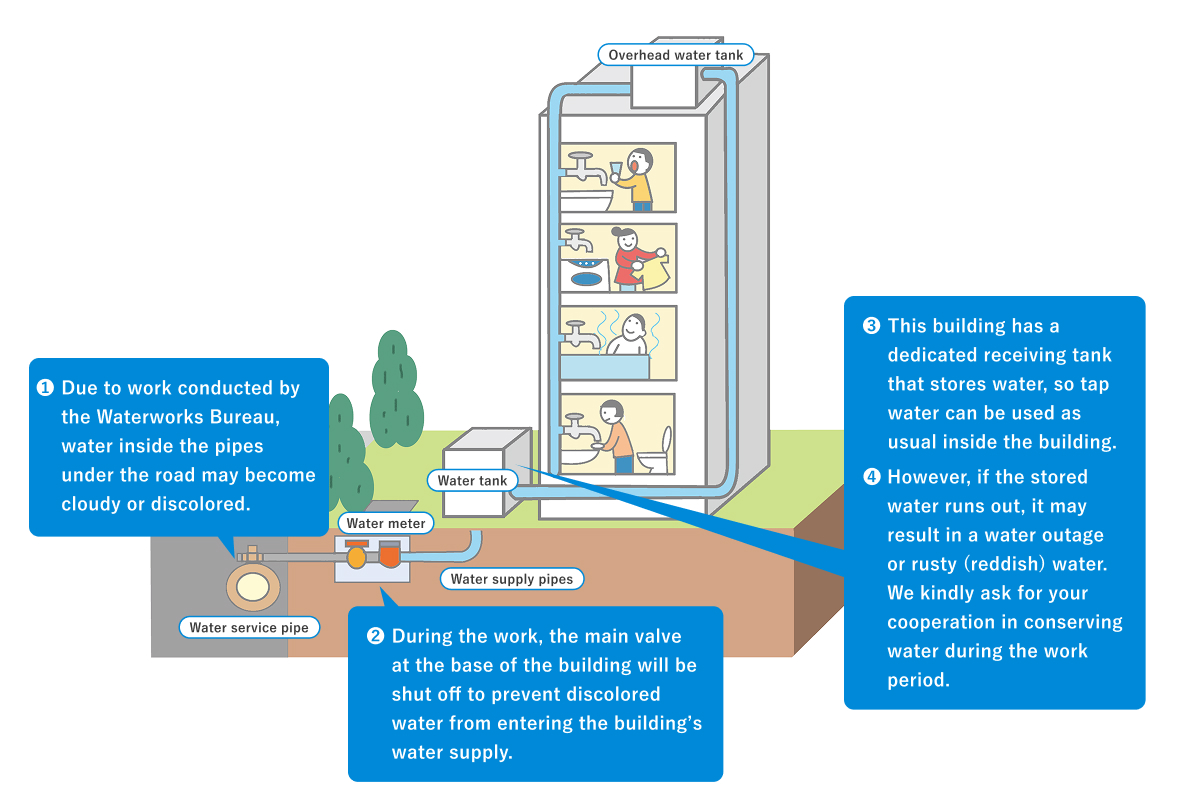
- ●Please note that water supply to the building’s receiving tank will be temporarily stopped before the maintenance/cleaning work begins.
- ●During the work period, faucets and tap water can still be used, but please try to limit usage as much as possible, as the receiving tank has a limited amount of water. If the receiving tank runs out of water, all units in the building may experience a water outage, and rusty (reddish) water may also occur.
- ●Once the scheduled work period has ended, you may resume using faucets and tap water as usual. (Please note that there will be no notices to announce the end of the work)
- ●Water supply to the building’s receiving tank shall resume once the work is completed.
Frequently Asked Questions:
Q9: What is a receiving tank (受水槽 jusuiso)?
A9: A receiving tank is a tank installed in buildings such as offices or apartment complexes to temporarily store
water supplied from public water pipes. The receiving tank is considered to be the property of the building owner,
and it is the owner’s responsibility to maintain and manage the tank.
Q10: Who is responsible for stopping the water supply to the receiving tank during maintenance/cleaning? Who is
responsible for contacting the tank management company?
A10: Kobe City will coordinate with the owner of the receiving tank, and either the owner or the Waterworks Bureau
will shut off the main valve to stop the water supply. After the work is completed, either the owner or the
Waterworks Bureau will reopen the main valve.
The Waterworks Bureau will notify the tank owner about the maintenance/cleaning work details (date, time, and nature
of the work) in advance. In addition, receiving tanks are typically equipped with alarm systems that detect abnormal
water levels, so city staff may request that the alarms be temporarily disabled during the work period.
Q11: What sort of issues might occur if the receiving tank runs out of water?
A11: Receiving tanks have a limited capacity. If the amount of water used in the building exceeds the tank capacity
and the tank becomes empty, the following issues may occur:
・ Water supply to each unit will stop, resulting in a complete water outage throughout the building
・ When water is resupplied to an empty tank after the work is completed, rust and other sediments that have settled
at the bottom may be stirred up, causing rusty (reddish) water
・ Appliances that take in said rusty water may experience issues in water flow and/or malfunction